Does predicting the next view build better memory?
An intelligent system can predict what comes next and still forget the fact that matters later. BeliefSpec asks when auxiliary prediction makes a recurrent state more useful for a delayed decision.
The pilot isolates this question in a small, partially observable task: briefly see a key or ball, follow a scripted route, then choose between two objects after the clue has disappeared. The model learns the final choice; navigation is controlled by a fixed script.
Prediction is a proxy. Useful memory is the goal.
World models are often trained to predict observations. That objective is useful only insofar as the learned representation preserves information needed downstream. A predictable hallway can dominate the next-view target while an earlier, decision-relevant clue becomes invisible.
This experiment separates local prediction quality from delayed decision performance. It is a controlled supervised study, rather than an evaluation of autonomous navigation, reinforcement learning, or LLM agents.
Observe the clue
The agent sees a key clue. It tells the agent which choice will be correct later.
key clue visible
Key → top choice
Simplified illustration of the delayed-clue question. Not a model rollout or a reproduction of the full MiniGrid environment.
One early clue. One delayed decision.
Each episode provides a 7 × 7 categorical MiniGrid object-ID view, direction, previous action, and a public route phase. Mission text, rewards, hidden clue labels, episode IDs, full maps, and evaluator metadata are excluded from the permitted inputs.
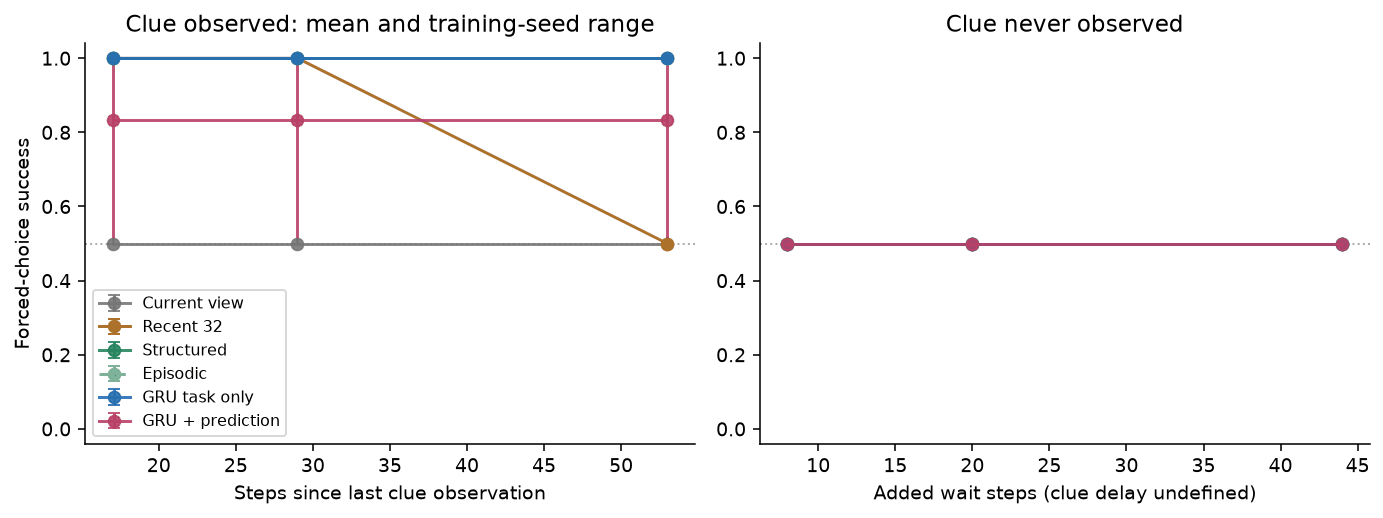
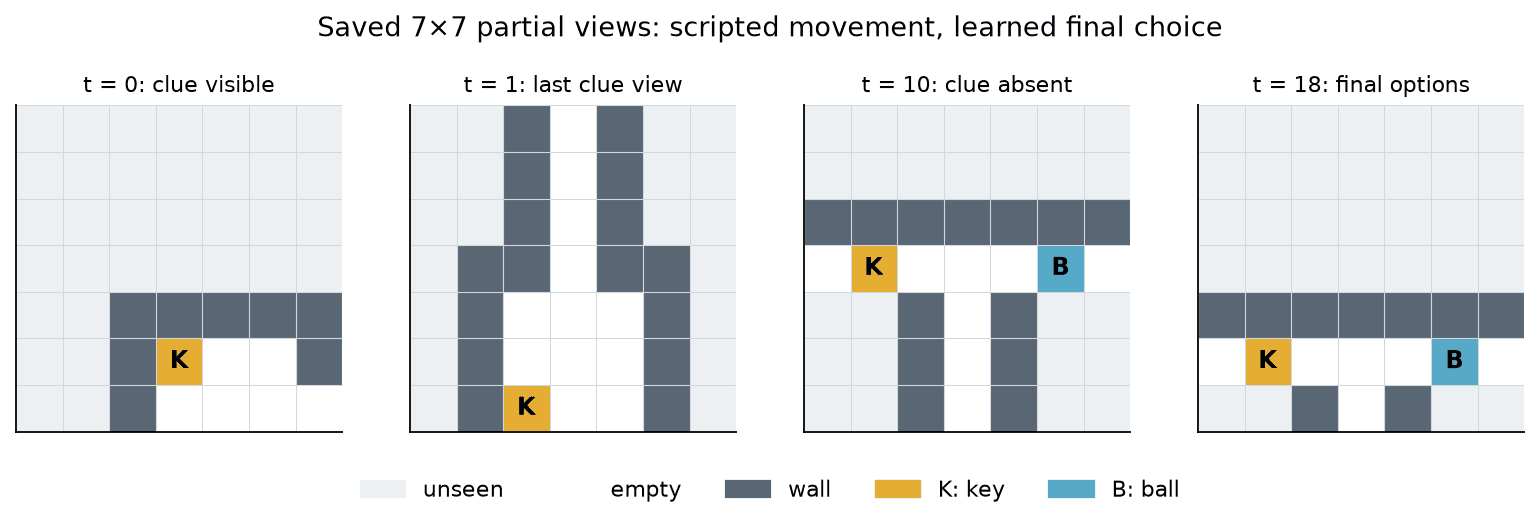
In observed episodes, the clue is briefly visible near the start. In never-observed episodes, every view of its cell is masked. Observed test delays are 17, 29, and 53 simulator steps since the last visible clue. The saved illustration shows actual partial observations; it is not a full map visible to the model.
The readout predicts key, ball, or unknown. A common controller converts those probabilities into a top-or-bottom choice. This distinguishes correct memory from a lucky forced choice: an uncertain readout can occasionally select the right option without retaining the clue.
Six ways to carry information forward.
Every method produces the same key/ball/unknown probability vector before the shared controller. The structured and episodic methods verify task solvability; they are not matched learned architectures.
- Current view: tests whether the final observation alone leaks the answer.
- Recent history: checks whether a 32-frame window still contains the clue.
- Structured memory: parses and retains observed clue facts.
- Episodic retrieval: stores clue-stage observations and retrieves the relevant frame.
- Task-only GRU: learns recurrent memory from final clue classification.
- Predictive GRU: adds next-view prediction to the same recurrent architecture.
Matched models, held-out trajectories.
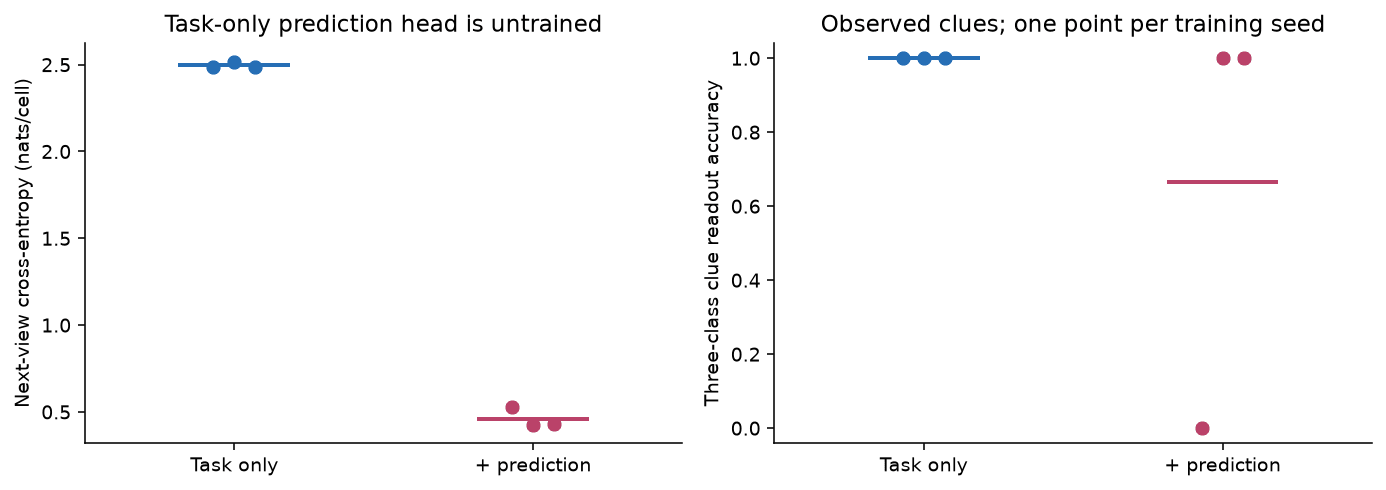
The two learned variants allocate 56,171 parameters each, including the same 32-dimensional recurrent state. The control prediction head is present but untrained. The predictive objective is task cross-entropy plus 0.1 times categorical next-view cross-entropy.
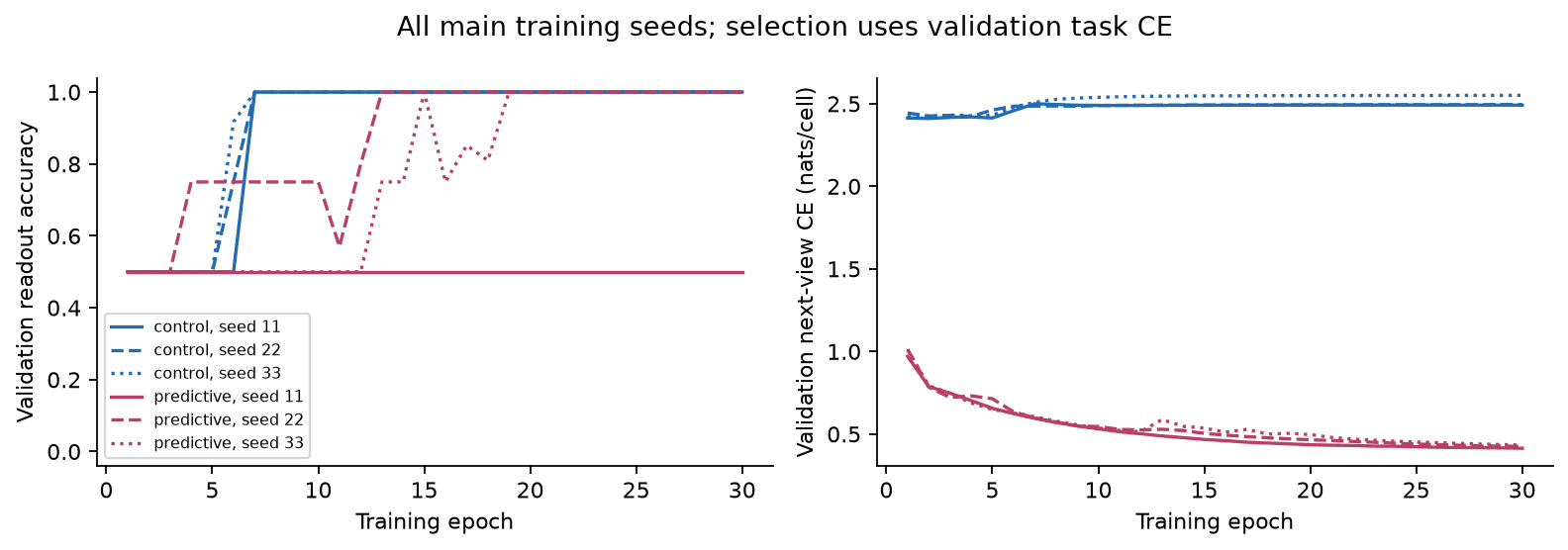
The predictive head uses the current recurrent state and executed action to predict the next observation. Sequence padding is masked. Hidden state resets per episode, and train, validation, and test route offsets are disjoint. Validation selects the checkpoint; held-out test trajectories are evaluated with fixed weights.
Each training seed has 384 observed-clue test episodes, equally weighted across the three delays, and 384 never-observed episodes. Seeds 11, 22, and 33 provide three training replications per learned condition.
Better local prediction did not improve reliable choice.
Across seeds 11, 22, and 33, task-only observed-clue success was 100%, 100%, and 100%. Predictive observed-clue success was 50%, 100%, and 100%. All methods scored 50% forced-choice success when the clue was never observed.
The paired predictive-minus-control mean was −16.67 percentage points. The descriptive 95% seed-level t interval was [−88.38, +55.04] percentage points. With only three training replications, that interval is unstable; the many test episodes do not become independent training replications.
The predictive arm learned the auxiliary target. Its lower prediction error does not establish an advantage over a trained prediction-only baseline: the control prediction head was untrained. Saved figures preserve seed ranges and learning histories rather than presenting them as broader uncertainty estimates.
Does the target even require the clue?
A post-hoc audit compared 192 matched opposite-clue episode pairs with the same routes and choice placements. There were zero differences in 6,336 post-clue next-view target comparisons. The target no longer depended on the earlier clue after it disappeared.
That audit exposes a mismatch between local prediction and decision-relevant memory in this environment. It does not establish the cause of predictive seed 11’s failure.
A narrow result, with visible limits.
The task-only control is at ceiling, so there is little room to detect improvement. Three seeds, fixed geometry, short training budgets, and repeated route structure limit generalization. Structured and episodic baselines are task-validity checks.
The pilot does not show that predictive supervision is generally harmful or beneficial. It does not test layout generalization, autonomous control, LLM agents, or a reproduction of AgentSpec. The defensible finding is that better local prediction was insufficient to reliably improve delayed decision memory here.
Make the prediction target depend on what matters.
A stronger follow-up would preregister a fresh, non-ceiling task in which predicting future observations requires retaining the clue. Additional independent training seeds and new layouts would help distinguish target design, optimization, and generalization effects.
The next research question is which predictive targets preserve decision-relevant state under partial observability, and how to measure that retention independently from the ease of predicting the immediate scene.
Inspect the evidence, then reproduce.
The repository includes an exploratory working paper, saved episode records, frozen configurations, traces, review audits, and figure-generation scripts. Follow the repository README for Python 3.12 and uv setup and write reproduction outputs to a fresh directory to preserve original evidence.
The original and review runs used CPU-only Apple Silicon hardware. Cross-platform bitwise equality is not promised.
Figures